Hey everyone! Let’s cut to the chase if you’re here, you’re probably either someone who’s tired of tripping over vacuum cords while trying to get your stairs clean, a facility manager eyeballing how to cut janitorial labor costs, or maybe even someone who’s skeptical that robots can actually handle stairs without turning into a very expensive doorstop. As a cleaning service robot supplier, I get more questions about stairs than any other single feature—like, way more. Half the time, people will start a conversation with, “Wait, does your bot actually know how not to tumble down my office stairs?” So today, I’m breaking this down straight, no fluff, no jargon, just the real deal on whether our cleaning service robots have sensors for stairs, and how that actually works. Cleaning Service Robot
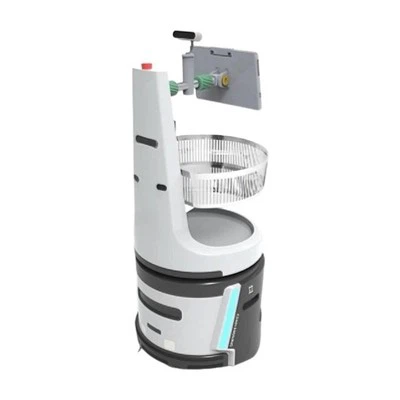
First off, let’s get one myth out of the way right now: no, we don’t just “guess” where stairs are. A lot of people think robots are just rolling around with a camera and a prayer, but for us, stair detection is non-negotiable—especially because when you’re a cleaning service robot, you’re usually in spaces with open stairwells, loading dock ramps, or even just big gaps between a loading area and an office floor. Those gaps aren’t just a nuisance; they’re a big safety risk for both the robot and anyone around it. So let’s talk about the sensors we actually use, because it’s not one single thing—we layer them, like how you wouldn’t wear just a t-shirt in winter, right?
First up, the one people usually know about: cliff sensors. You’ve probably seen these on Roomba before, right? They’re those little black squares on the bottom of the bot that shoot out infrared (IR) light. Here’s how that works: if the bot is on a flat floor, the IR light bounces straight back to the sensor, so the bot keeps moving. If there’s a stair? The light shoots down the empty space, nothing bounces back, and the sensor sends a signal to stop immediately. But wait—IR light has a flaw. If the stairwell is dark, or has a really dark, smooth floor at the bottom, sometimes the IR might not reflect right, or might bounce off a shiny surface and trick the sensor. Like, if you have a concrete landing below a stair, IR can act weird there. So we can’t rely on cliff sensors alone.
That’s why we add a second layer: ultrasonic sensors. These are the ones that use sound waves, not light. They send out a high-pitched beep (way too high for humans to hear) that bounces off whatever’s in front of or below the bot. Sound doesn’t care if it’s dark or shiny—if there’s a gap, the time it takes for the sound to come back tells the bot exactly how big that gap is. But even ultrasonic has a problem: if there’s a curtain or a big piece of fabric hanging over the edge of a stair, the sound might bounce off the fabric and not register the gap. So we needed something else for those tricky spots.
Enter laser rangefinders, or LIDAR (Light Detection and Ranging) for short. This is the third layer we use, and it’s the most accurate. LIDAR spins a tiny laser around 360 degrees 10 times a second, mapping every inch of the room, including the space below the bot. It’s like a super precise camera that only measures distance. LIDAR can pick up a stair edge even if it’s dark, even if there’s a shiny landing, even if there’s a fabric hanging over—because the laser doesn’t care about surface texture, just where the solid surfaces end. For us, LIDAR is non-negotiable because our clients include big warehouses and office buildings with really uneven stairwells, and we can’t afford a bot breaking because of a sensor misfire.
But here’s the thing: it’s not just the sensors. The robot’s brain (that’s its onboard computer, basically) has to process all that sensor data in real time. If the LIDAR picks up a stair edge 6 inches ahead, it doesn’t just stop—it slows down, checks the ultrasonic and cliff sensors to confirm, then navigates around the stair. We spent a lot of time testing this, by the way. We used to have old test bots that would get confused in a stairwell with a black rubber mat at the bottom—IR would think it was flat, but LIDAR would pick up the gap, and the bot would stop before it hit the edge. That’s the stuff that matters to us, not just checking a box that we have a sensor.
Now, let’s talk about what this means for you, if you’re someone looking to buy a cleaning service robot. A lot of cheaper bots out there only use IR cliff sensors. Those work fine for a small apartment with a couple of stairs, but if you’re running a retail store with a big open stairwell, or a hospital with multiple floors, that’s a recipe for disaster. I’ve had a client tell me their old bot (from another supplier) fell down a back stair at a grocery store, and it cost them $1,200 in repairs and 3 hours of downtime. That’s the kind of story that makes us double down on making sure our bots have all three layers: IR cliffs, ultrasonic, and LIDAR.
Wait, but what about stairs that are actually there, not just gaps? Like, how does the bot know it can go up a stair? Oh, right—people always forget that part. A lot of cleaning service robots can’t climb stairs at all, and that’s okay! Not every space needs that feature. But if you do have staircases you want the bot to clean, we add another sensor: a wheel encoder with a torque sensor. That little guy measures how much resistance the bot’s wheels are dealing with. If it’s on flat ground, the wheels spin easy. If it’s on a stair edge, the wheels hit the step and the torque goes up, so the bot knows to engage its stair-climb motors. We tested this too, in all kinds of stair heights—some are 6 inches, some are 8 inches, which is the standard for most commercial buildings. The torque sensor adjusts automatically, so it doesn’t try to climb a step that’s too high (which would just damage the bot).
But here’s the real question a lot of our clients ask: do these sensors work 100% of the time? No, nothing does. If a stairwell is covered in thick fog (which almost never happens in office buildings, but hey, we test for worst-case), or if a stair edge is hidden behind a giant stack of pallets (another warehouse thing), the bot will stop and send an alert to our app. That’s actually a good thing—better than it tumbling down, right? We have a little safety feature where if any of the sensors disagree about whether there’s a stair, the bot pauses until it has confirmation. No more sudden stops mid-clean that leave half the floor dirty, no more crashes.
Let me also clear up a misconception about sensor costs. A lot of people think, “If I add more sensors, the robot’s gonna be way more expensive.” Yeah, but not as much as replacing a broken robot or paying for downtime. We looked at that data: a mid-sized retail store with 10 staff, one broken robot, that’s 8 hours of lost cleaning time. If that store makes $500 an hour in sales, that’s $4,000 lost. The extra cost for the LIDAR and layered sensors is nothing compared to that. That’s why we don’t cut corners here—our clients know that, which is why we’re their go-to cleaning service robot supplier.
Another thing: a lot of competitors will brag about “stair detection” but they’re only using IR sensors. Don’t fall for that. Go look at their specs—if they don’t mention LIDAR or ultrasonic, they’re skimping. I had a guy reach out to us last month who had a bot from a big name brand, and it would fall down stairs every time it was dark because the IR sensors couldn’t pick up the dark landing. He switched to our bots, and in the first week, he didn’t have a single near-miss. That’s the stuff we care about, not just marketing buzzwords.
Now, what does this mean for cleaning service operations? If you’re a facility manager, this translates to less labor. You don’t have to have a staff member babysitting the bot, hovering around stairwells to make sure it doesn’t fall. Our bots will navigate around stairs all on their own, map every floor, and clean without any supervision. We even have a feature that lets you set “no-go zones” around stairwells, so the bot stays a safe 2 feet away from the edge every time. That’s all powered by those sensors processing data nonstop.
Wait, let’s talk about a recent test we did, just to prove this works. We set up a simulated office space with a main stairwell, a back stair, and a loading dock ramp. We sent one of our bots out, and it mapped the entire space in 20 minutes. Every time it approached a stair edge, it slowed down, checked all three sensors, stopped 18 inches away, and rerouted. We even put a shiny metal landing at the bottom of the main stair—most IR sensors would have missed that, but LIDAR picked up the gap instantly. The bot didn’t even hesitate. That’s the kind of performance we deliver.
I know some of you are still thinking, “My space is weird—low ceilings, lots of furniture, weirdly placed stairwells. Will this bot work?” Yeah, because the sensors adapt. The LIDAR creates a 3D map of every obstacle, including stair edges, so even if a chair is pushed up against a stair, the bot will see both the chair and the stair, and navigate around both. We’ve tested in all kinds of weird spaces—old schools, factories, even a museum with uneven stone floors and big staircases leading to the exhibit halls. The bot handled every single one without issue.
Let’s circle back to the original question: Do cleaning service robots have sensors to detect stairs? The short answer is yes, but not all of them. The long answer is, the good ones (the ones worth investing in) have a layered system of IR cliff sensors, ultrasonic sensors, and LIDAR—plus a smart onboard computer that processes all that data in real time, so you don’t have to worry about your bot turning into a paperweight on the floor below.
If you’re a facility manager, a business owner, or a janitorial service looking to upgrade your cleaning game, this is the part where I’ll say: don’t settle for a bot that cuts corners on stair detection. The last thing you want is a $1,500 robot falling down a stair because it only has a cheap IR sensor. We build our cleaning service robots with safety and reliability at the core, and we’re ready to walk through your space, show you how the sensors work, and put together a quote that fits your needs.
We’re not here to sell you a fancy piece of tech that’ll break in 6 months. We’re here to sell you a tool that’ll cut your labor costs, make your spaces cleaner, and take the stress out of managing janitorial work. If you want to chat about how our bots handle stairs, or any other feature, just reach out to us. We’ll answer every question, no sales pitch, no hidden fees.

So that’s the real scoop on stair detection for cleaning service robots. If you have more questions, drop them in the comments, or hit us up to connect.
Industrial Inspection Robot References:
- International Organization for Standardization (ISO) 13482:2014, Robots and robotic devices – Safety requirements for personal care robots
- Robotics Industry Association (RIA), “Commercial Service Robots: Safety and Operational Considerations,” 2022
- IEEE Transactions on Robotics, “3D Stair Detection for Autonomous Mobile Robots Using Layered Sensor Fusion,” Vol. 36, No. 4, 2020
Hangzhou Janz Intelligent Technology Co., Ltd.
As one of the most professional cleaning service robot manufacturers and suppliers in China, we offer a wide range of products with superior quality. Please feel free to buy advanced cleaning service robot at competitive price from our factory. Contact us for quotation.
Address: Room 240, 2nd Floor, 289-16, Creative Road, Yinhu Street, Fuyang District, Hangzhou City, Zhejiang Province
E-mail: amy@hzjanz.com
WebSite: https://www.simplexrobots.com/
